of USM Inc. Those images and the text may be used by others ONLY AFTER completion
of a formal international licensing agreement and payment of a licensing fee!
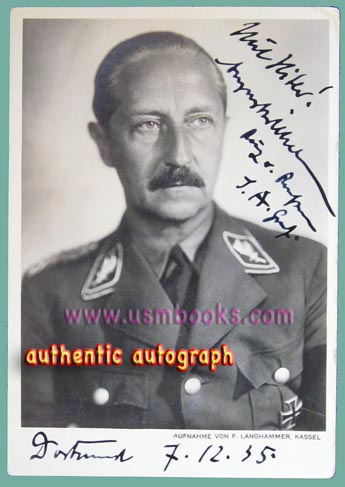
Known as “Auwi”, the contraction made from the first two letters of his first two names, Prussian Prince August Wilhelm Heinrich Günther von Hohenzollern was the fourth son of Kaiser Wilhelm II of Germany by his first wife, Augusta Viktoria of Schleswig-Holstein, a relative of British Queen Victoria. He grew up in the Neuen Palais at Potsdam. After studying in in Bonn, Berlin and Strassburg he obtained his doctorate degree in political science in 1907 (Doktor der Staatswissenschaften).
On his mother’s 50th birthday, 22 October 1908, he married Princess Alexandra Victoria of Schleswig-Holstein-Sonderburg-Glücksburg, with whom he had one son: Prince Alexander Ferdinand Albrecht Achilles Wilhelm Joseph Viktor Carl Feodor of Prussia. They divorced in 1920 (she remarried). He fought in WWI and after the war joined the conservative veteran group the Stahlhelm. He stayed in Germany when his father Wilhelm II and oldest brother Crown Prince Wilhelm fled to Holland in November 1918.
On 1 April 1930 against the will of his father he joined the NSDAP and in 1933 he became a member of the SA and the Reichstag (Wahlkreis Potsdam). He was a frequent speaker at NSDAP events in the early years, as son of the Kaiser he was an prominent attraction, a magnet for more conservative and traditional German voters. He wore the Golden Party Badge and in 1939 he was promoted to the rank of SA-Obergruppenführer, or General. He lived in his Villa Liegnitz on the grounds of Sanssouci Palace in Potsdam near Berlin for much of World War II.
In the beginning of February 1945 he fled Potsdam and Berlin prior to the arrival of the Red Army. With Crown Princess Cecilie, wife of his oldest brother Crown Prince Wilhelm, he fled to Kronberg (near Darmstadt) home of Margarete Markgräfin von Hessen, one of his father’s sisters. There he was arrested by the US Army on 8 May 1945 and subsequently sentenced to three years in jail. Upon his release in 1948 there was a German warrant for his arrest in Potsdam but nothing came of it. “Auwi” died the following year at age 62 in a hospital in Stuttgart. He is buried at the Friedhof der Fürsten von Hohenlohe-Langenburg (Cemetery of Kings) at Langenburg.
This rare autographed photo postcard shows Prinz August-Wilhelm von Preußen in a high-ranking SA uniform with an Iron Cross on the chest pocket of the uniform. With a fountain pen he signed Heil Hitler! above August Wilhelm Prinz v. Preussen and SA Grup. Below the portrait he wrote the place and date, Dortmund 7 . 12. 35.
This card was never mailed and has a blank back. The only thing printed on the back is "Prinz August-Wilhelm von Preußen", there is no manufacturer or publisher information. Very good condition and all aspects of it are absolutely authentic to the Third Reich period.
THIRD REICH
AUTOGRAPHED
PHOTO POSTCARD
OF PRINZ
AUGUST-WILHELM
VON PREUSSEN
(AUWI)
|
This rare autographed photographic Nazi postcard of 'Auwi',
Prince August-Wilhelm of Prussia is **SOLD**. We will be happy to ship abroad at additional cost. Please inquire. |





This is a splendid professional photograph by Kassel photographer F. Langhammer of the fourth son of the last German Kaiser, Wilhelm II. He was Prince August Wilhelm Heinrich Günther Viktor of Prussia, also known as "Auwi".
Prince August-Wilhelm signed this unused 105 x 148 mm photographic postcard on 7 December 1935 in the city of Dortmund.